Thursday, February 4, 2016

• cli-fi bullets -- 100 "ruminations" (rumes) on what Cli-Fi is and where it is headed (literary and philosophical zen-like rumes)

• cli-fi bullets

100 "ruminations" (rumes) on what Cli-Fi is and where it is headed (literary and philosophical zen-like rumes)
 
• 100 short zen-like ruminations on literary and philosophical aspects of ''cli-fi''
by the man who coined the term
 
 #CliFi hashtag on Twitter

SAMPLES:

[Cli-fi bullets: random thoughts about cli-fi in 140 characters (more or less) that first appeared on Twitter]

Cli-fi literary theory does not exist yet. It is that new. We are flying by the seat of our pants. The future beckons.

Cli-fi tries to answer philosophical questions about the fate of our species. There is no canon, no agenda, no school. You write it, we read it.

•  Cli-fi delves into the future as a way to analyze our current dilemma, here and now. Who will live to see the 25th Century?

Holocene, Anthrocene, Anthropocene. Cli-fi explores all scenes and judges all. Who let us down? Who will raise us up?

Teaching climate science is the role of school teachers. Writing cli-fi is the role of seers,  visionaries, dreamers, prophets.

There has never been a time like this in human history when so much is at stake. Will cli-fi answer the call?

How on Earth did we end up this way? Who on Earth will have their say? Arise, all ye who write cli-fi.

There's no accounting for the predicament we're in. No one to blame, no one to name. Or is there? Cli-fi sees all.

Children born today are no different than children born before. But they will grow up to read, write cli-fi. (And. Face. Facts.)

Cli-fi is not a science, and it is not science. It is a literary genre in search of redemption, grace, salvation. It is your turn to try.

There will come a time when shoulders shrug, when faces droop,  when smiles fade. But cli-fi can save the day. Arise!

If cli-fi is to serve any real purpose, it must soar above distractions and land in the public square. Discuss it, write it.


Cli-fi has no canon, no school, no leader. It belongs to all who embrace it. Use it as you will.


 In some future time, say 2085, people will look back at the rise of cli-fi in 2015 and wonder why and how it grew. Who knew?

 Do you cli-fi? Do you "do" cli-fi? Do you read or write or research cli-fi? Welcome aboard.

  Cli-fi exists not to promote careers or obtain research grants or government funding. No, cli-fi just is. And rising.

  Cli-fi is rising, yes. It's in the air. It's time has come. There is no wormhole that can stop it.

  In the best of all possible worlds, there would be no need for cli-fi. Unfortunately, we live in cli-fi times. In a cli-fi world. Face it.

  This is the Age of Cli-Fi, in the Antropocene, after the Holocene. It's not a pretty picture, is it?

  Who invited you to the house of cli-fi? No one. You came of your own accord, to look, to see. It's an open house.

  You write cli-fi because it gets under your skin and you can no longer look away. Peer into the future and tell us what you see.

  The house of cli-fi welcomes everyone. Come in, look around, take a seat. There are books to read. And write.

  I never met a future I didn’t like. No, that can’t be true. Some futures spell the end of humankind. It’s in the cards. Choose your exit.


• Cli-fi isn't a marketing term or a bookstore shelving category, and it's more than a literary term. It's a password into the future and those who know it, know.

• ​Cli-fi is more than a genre term, much more than that: it's a code word, a password, a secret handshake; it is bringing us together as one

• ​Cli-Fi is not for you or your children or grandkids, no. It's codeword for future generations, as yet unborn. And born they shall be. In next 30 generations.​

• ​Cli-Fi cannot, will not, save us from what's coming. Too late for that. But it's here, now, always. We have 30 generations to prepare. See?

• In the future, come 30 more generations of man, there will be no Cli-Fi. By 2500 A.D. (Anthrocenus Deflexus)it will be too late.

• People want cli-fi to offer solutions, comfortable happy fixes. Aint gonna happen. We are ''doomed, doomed'' as a species, and we did it to ourselves.
​• Cli-Fi cannot, will not, save us from what's coming. Too late for that. But it's here, now, always. We have 30 generations to prepare. There's time.
​​
​• Cli-fi won't make much of a difference either way you define it. It's just here, now, beckoning future writers. It's not sci-fi, never was
• Cli-fi is more than a mere genre: it's a cri de coeur, a warning flare, a pathway to the future before it's too late. See? #CliFi's here now​
• If the rising new literary term "cli-fi" makes you 'cringe' at first sight or hearing, don't give up on it yet. With time, you will come to see it for what it is.

•​ Cli-fi is not sci-fi, it is not eco-fiction, it is not subgenred to anything earlier. Cli-Fi is a hashtag burning its stamp into our very skin, as we prepare.

• ​Cli-fi is more than a genre term, much more than that: it's a code word, a password, a secret handshake; it is bringing us together as one.
• Cli-fi wasn't just a case of slapping a new name on an old genre. It's much deeper and existential than that. Think game-changer, new directions.
• We'll never make it out of here alive. That's cli-fi in a nutshell. Man the lifeboats, prepare to test the seas of one season after the next.
• Cli-fi defines a line the sands of time that no man can cross without trepidation or reverence. There's a reason we are here. What is it?
• If cli-fi is one thing, it's a chance to choose our future. One door leads here, another door leads there. Choose wisely: Your descendants are waiting.
• There's a tragic flaw in our genes, a selfish shellfish that doesn't want to share. This DNA will be our downfall. This Earth shall abide.
• Cli-fi doesn't choose sides. We do. Choose your weapon, use it wisely. We are here by the grace of God, and someday we won't be. God knows.
• You could say that in a post-sci-fi world, cli-fi has come to rescue us from oblivion. Not true. No way.
• You might not really be interested in cli-fi, or where it is going. But trust me, cli-fi is interested in you. Why? Becos the End is nigh
• When all is said and done, cli-fi points in only one direction. It's for everyone to find it on their own. ON THE BEACH from 1957 has clues.
• Cli-fi is not about who coined it or who popularized it. It's about much more pressing things, like how many more generations before the End?
• I never met a future I didn't like. No, that can't be true. Some futures spell the end of humankind. It's in the cards. Choose your exit.

• Cli-fi is neither pro nor con. It just is. Take your pick. Choose yr sides. We are at war w/ a future that threatens all futures. Arise!

• Cli-fi is so much a part of this world that on first hearing the word or seeing it in print, it slips right by, invisble, unnoticed.
•If by some remote chance you find yourself reading a cli-fi novel without realizing it's cli-fi, you have arrived.
• There are are still 30 generations to be born before the real apocalypse begins. This now is just a rehearsal. An audition.
• Cli-fi leads to a meeting of the minds, borderless, rudderless, unconsolable. Will we get there on time?
• If you think time is running out, or has already run out, in terms of the unspeakable cli-fi future we face, you are very close to solving the riddle. Why are we here?
• I don't want to sound pessimistic, as optimism must abound and console us. But listen to the wind, hear the chimes sing, ring.
• Cli-fi has a place in our hearts and minds, now and forever. But forever is no longer forever. We sold the farm.
• Cli-fi can, and will, shine a light on the darkness that is about to befall us. Let's stick together and shoulder the burden.
• You didn't know cli-fi was coming. Nobody did. It's taken us by surprise.
• There will be days when cli-fi is beyond us, unscoutable, undetected. All the more reason to pay attention.
• Cli-fi doesn't mean resignation or giving in to the darkness ahead. To the contrary, it means taking up arms.
• If a time shall come when all else fails, cli-fi may just come to the rescue. Make room.
• Cli-fi cannot answer all our questions or undo the deeds we have done. No. But she can unburden us of our fears.
• There will come a time when there is no time left. That's where, and when, cli-fi comes in.
• Who will write the cli-fi of the future? They will be legion, legends. Welcome them.
• Cli-fi is more than a mere genre term, much more than a literary term. It's a battle cry, a cri decoeur, a shout-out to future generations: "We tried to warn you!"
• Think positive, think cli-fi. Think future generations, think now. Think the end is nigh unless we change our ways.
• There is no way out of here, said the sailors to the sun. Thirty more generations is all we have left. What then?
• Ploddingly, one step at a time, we are marching to future days. Cli-fi cannot stop the deluge, yet we must not surrender. Never.
• With sea levels rising in future times, Nature has been turned on its head. Cli-fi paints a picture, sight unseen.
• If we could see CO2, smell it, know that is there, over-loaded, we might be able to put out the fires. But it is invisible, odorless.
• Whatever generation you belong to, know in your heart that there is no way out of here. Nature has spoken, Earth recoils. Write on.
• To show respect to the Earth, which is our home in the cosmos, please always capitalize the word as ''Earth.'' Earth matters, tell the copy desk. Lowercasing it is beneath us.
• Cli-fi cannot, will not, lead the way. This is a clean-up action, and way too late. But it matters nevertheless.
• One cannot see the future, cli-fi is blind. But the stories we tell will matter, even if it is all for naught.
• Cli-fi, by indirection finds direction out. Your words on the page must be balanced, insistent. Always. And never lose hope.
• Not doomed yet? What will it take to connect the dots? Not doomed yet? Some overly-rosy displays of optimism in print could be seen as pathological.
• As humans, ike all life forms, we are hardwired and programmed to believe that the near future will be similar to the recent past. Our Achilles heel, so to speak.
• Cli-fi won't solve our problems, and can't undo what's done. Fasten your seatbelts. This is a ride to Hell.
• Climate change is more than a fact of life. It is the result of human ingenuity, greed, rapaciousness and fear. Fear not: cli-fi is here. Write it.
• I came to the table naive and unquestioning. I left totally convinced there will be dead people, lots of dead people. That was the genesis of cli-fi.
• You might not want to go down the cli-fi road, and that's okay. It's not a pretty picture, not a happy selfie. It's disaster, writ large.
• In the long and rambling history of humankind, cli-fi will be just a blip on the radar screen. Pay it no heed.
• You weren't born yesterday. Your descendants may not even be born at all, ever. That's how unfathomable cli-fi is.
• If you can manage to fit the personal stories of cli-fi between the covers of a book, do it. With trepidation. Know your audience.
• Cli-fi will have no denouement, no act three, no happy ending, no Greek chorus, no social media take-away. Push send.

• Sorry, but this is how cli-fi is going to be, in the Anthropocene. Just 12 letters spelling doom.

• I wish there was some cli-fi way out of here, but there ain't. Ain't ain't ain't. Ain't ain't ain't times, ten thousand times ain't.


Saturday, January 16, 2016

Hollywood shuns climate-themed movies for 2016 Oscars telecast. Why?

Will the Hollywood sign in 2100 still be there?


By Dan Bloom
If there really is a strong liberal, progressive presence in Hollywood -- and there is, from producers to directors to writers --  then where are all the global warming-themed movies
in Tinseltown? They just aren't getting greenlighted.


With the recently-concluded COP21 climate talks in Paris reaching a successful agreement
in
​mid-​
December, the current list of
​O​scar
nominations doesn't
​include even one
single movie with a
​climate
theme.
​I wondered why and decided to get on the email phone with two experts I trust on this: Edward Rubin at Vanderbilt University in Nashville and Michael Svoboda at George Washington University just a few city blocks from the White House.

Rubin, born and bred in Brooklyn and in his mid-60s now, is the author of a new cli-fi novel titled "The Heatstroke Line," and he's teaching a cli-fi course this semester at Vanderbilt called "Climate Change Literature: a New Fictional Genre about a Real Problem." 

I asked the law professor, who earlier in his career worked as an entertainment lawyer for some Hollywood producers, what his take was on the movie capital of the world turning a blind eye to climate change themes, even when the newspapers are full of climate science news items every day now.

​"Climate-themed movies can play a crucial role in educating people worldwide about climate change," Rubin told me by email. "To begin with, people will watch the movie and be moved by it, and they are not going to just look at government charts and scientific research papers."

''Even more important, movies can present scenarios that make large events comprehensible and future possibilities concrete," he added, noting: "What is truly false, and belongs in the category of puerile fantasy, is to deny that climate change is occurring. The fact is that many of the grim possibilities portrayed in a cli-fi movie will become realities unless we take global concerted action."
 
 
For Svoboda, an assistant professor of writing and director of the Sustainability Minor at GWU as well as a regular contributor to Yale Climate Connections, where he first began to write about climate change in popular culture, Hollywood's fear of making climate-themed movies sets a bad example for other film capitals around the world, from Bollywood to London. Where Hollywood producers should be leading, they are being lazy and running on fear. The author of a recent academic paper titled "Cli-fi On the Screens," a survey of climate change in over 60 feature films, the professor has done his homework.

"For the big Hollywood studios, I think the fear of alienating a segment of the market, due to the polarization of the climate change issue in the U.S., is a factor in whether to incorporate 'climate change' into a plot," he told me. "That seems to have been the case with 'Mad Max: Fury Road.' For the smaller studios, the ones making movies for network and cable TV channels, I think there's a sense of 'been there, done that.' They've moved on to the latest fear in the daily news cycle. And neither group seems to understand the challenge. Climate change doesn't fit into the stories they've been trained to tell."


I asked Svoboda if he thinks things will change.

"I hope so," he said. "As the evidence mounts that climate change is already changing weather patterns, which in turn are affecting the global economy and international relations, I think moviemakers will figure out how to combine the different elements of climate change -- extreme weather, economic impacts, the conflicts driven by food insecurities that result -- into coherent, compelling and new stories."

To move the public on this issue, these stories must also illustrate how we can make the social changes necessary to avoid truly dangerous climate change, Svoboda said.

And that may mean movies that look more like ''Too Big to Fail'' or ''The Big Short'' than ''The Day After Tomorrow,'' ''Into the Storm,'' or ''Snowpiercer."


In a recent oped article Svoboda wrote headlined "No Awards for the Academy on Climate Change this Year," he said that Hollywood producers and screenwriters seem cowed by the politics and confused by the challenge of climate change.
​"The 2015-nominated actors, directors, and films portrayed Cold War-era America, in several places, the Western frontier, the surface of Mars -- anything but the future we actually face," he wrote. "Even in ''Mad Max: Fury Road,'' a major theatrical release predicated on a breakdown of the environment, the words 'climate change' never appear."  


''Politics'' is certainly part of the answer, Svoboda told me.

''Over the last decade, climate change became embroiled in America's culture wars," he said. "A significant portion of the American electorate now views 'climate change' as a Trojan horse for 'the liberal agenda.' If a studio has invested millions to create a pop-spectacle, it will hesitate to include political notes that might sour its siren call."

Svoboda said he's hopeful that a new cohort of moviemakers, such as producer and climate activist Marshall Herskovitz, will face climate themes head-on in the future.

"The stories they greenlight in coming years may well influence what humans are able to achieve on climate change by 2100," he said. 
 
So how about it,
​liberal, progressive 
Hollywood? When will you start making
​global warming

-​
themed movies
​ for America's cineplex audiences
?​

Sunday, January 3, 2016

Cli-fi on the screen(s): patterns in the representations of climate change in fictional films


[FULL TEXT Embargoed Until January 31, 2016]

In a July 10, 2015 blog post, a journalist ...recalled the challenges separately issued in 2005 by Bill McKibben and Robert Macfarlane.

Where are the works of art, they asked, the fictional works about climate change?

In the 10 years since these questions were posed, the journalist argued, they have been answered—by cli-fi novels and cli-fi films.

American film critic  Michael Svoboda has written an academic study of cli-fi cinema for WIREs journal and it can be cited as ''WIREs Clim Change 2016, 7:43–64. doi: 10.1002/wcc.381''

Below is brief look at the article, with excerpts until the the story goes public at the WIREs website.

Fictional works about climate change, or cli-fi, have been hailed as a new genre. As a complement to previous WIREs studies of novels and plays, this article focuses on cli-fi films, providing an overview of some 60 films, including major theatrical releases, smaller festival films, and made-for-TV movies. Of the many possible impacts of climate change predicted by scientists, this study finds that filmmakers have focused on extreme weather events and the possibility of Earth slipping into a new ice age. These choices reflect filmmakers’ predispositions more than any scientific consensus and thus demonstrate the challenge that cli-fi films pose to climate change communicators. Finally, noting the recent emergence of films that parody concerns about climate change or that depict attempts to mitigate its causes or ameliorate its effects as possibly more disastrous than climate change itself, this study recommends that researchers in the humanities and social sciences look beyond ''The Day After Tomorrow,'' which has received far more attention than any other film.

© 2015 Wiley Periodicals, Inc.

MORE:

This overview is presented in  4  parts. First,
after very brief notices for six notable precursors,
55 films produced since 1984 are grouped by the climate
impacts they depict; then these groups are
reviewed for their unifying characteristics and distinguishing
differences. Only then, second, is the limited
academic literature related to cli-fi films reviewed.
(Because the cli-fi designation is relatively new,
because half of the films in this list are less than 3
years old, and because many made-for-TV and
straight-to-DVD films receive few critical notices, this
paucity of sources is not surprising.) To aid in applying
this literature to the much broader set of films
reviewed here, a critical framework is imported from
work on communicating climate change. Third, the
efficacy of these films is evaluated using this framework,
supplemented by critical observations provided
by the academic literature. The salient results of this
overview, and their implications, are then summed
up in a final conclusion.


THE FILMS

‘Cli-fi,’ for the purposes of this overview, excludes
documentaries and advocacy films even if, as in the
case of ''The Age of Stupid,'' they include fictive elements.

And while ‘film’ or ‘movie’ most readily suggest
feature films played in cinemas or theaters, this
overview includes fictional works produced for much
smaller screens, such as those found in art houses,
film festivals, or in homes and apartments (i.e., television
or computer screens). This means made-for-TV
movies and movies released only on DVD or blu-ray
are included, but only if they are full length (85 min
or more) and self-contained (a one- or two-part production).
On this basis film shorts and regular, multiepisode
TV programs were excluded.

Several
strategies were used to find the films reviewed here.
Keyword searches (‘climate change’ and ‘global
warming’) were conducted at the International Movie
Database (IMDB) website.Websites and blogs that
focus on cli-fi or on climate change and popular culture
were scanned for the titles they listed. Other
titles were found through the scholarly literature.
And several scholars who have published relevant
work were consulted by e-mail.

All but two of the films identified in this way
were English-language productions. This reflects both
the actual dominance of English language films in
this ‘genre’ and the difficulty of obtaining the few
non-English cli-fi films that exist. The two such films
that could be obtained (through a major online
American retailer) are both German films, Das Noah
Arch Prinzip (or The Noah’s Ark Principle, 1984)
and F4 (Vortex, 2006).

The former was included
because it is the first full-length work by Roland
Emmerich, the director of TDAT, and it likely
inspired The Storm, a movie made for TV in 2009.
F4 was included because it is discussed in one of the
early academic surveys of cli-fi films.

BLOG NOTE: [Svoboda then sorts these 61 films into seven groups: flooding/sea-level-rise, extreme weather events, into/in an ice age, melting poles, famine/drought, preclima(c)tic stress disorder, and antagonists.]


PREFACE

In a July 10, 2015 blog post, a journalist ...recalled the challenges separately issued in 2005 by Bill McKibben and Robert Macfarlane.

Where are the works of art, they asked, the fictional works about climate change?

In the 10 years since these questions were posed, the journalist argued, they have been answered—by cli-fi novels and cli-fi films.

In fact, by 2005 at least 14 novels about climate change had already been published in the UK and the United States, and what is still the most commercially successful feature film about climate change, The Day After Tomorrow4 (hereafter TDAT), had been released the year before (a point McKibben grudgingly acknowledged).

But the journalist is right: in the 10 years since McKibben and Macfarlane issued their challenges, there has been an outpouring of work.

So much so that the state of ‘cli-fi’ is now regularly updated in the pages of major news venues such as The Guardian and The New York Times ; in magazines devoted to political/cultural commentary such as Dissent and Salon ; in environmental newswires and websites such as ClimateWire, The Daily Climate, and Grist; and in film-trade publications such as Entertainment Weekly. Fictional works about climate change have also been addressed in the pages of WIREs Climate Change. In 2011, Adam Trexler and Adeline Johns-Putra provided an overview of ‘Climate Change in Literature and Literary Criticism.’ Then, in 2012, Stephen Bottoms covered ‘Climate Science on the London Stage.’

Friday, December 18, 2015

A powerful cli-fi feature film from director Brillante Mendoza captures full fury of post-Yolanda recovery efforts


[REPOSTED from The Huffington Post UK website:]

by Bethan Forrest

The seats are only just cold, the china barely packed away and the carpets hardly swept from the close of COP21 climate summit in Paris, the supposed summit to end all climate summits, as 195 countries across the world came together to negotiate their first agreement on tackling climate change in 20 years. Much hullaballoo was made of the opportunity to place binding agreements and targets to strike at the heart of the issue of global warming; to manage, to reverse and to prevent. Like much other fanfare, it was premature, undeserved and much hollow talk left a painful familiar ringing in the ears. The agreement lacks legally binding directives, assures no firm penalties and guarantees no real resultant reduction in global CO2 emissions which, in turn, hastens the horror of global warming rather than mitigates its effects.

And how have those effects been displayed in the media? We're used to apocalyptic images of great melting ice caps and dried lakes but little of the human or emotional cost of those caught in the eye of the storms and their dreadful aftermath ever reaches us. The terrible power of these extreme weather events decimates not only the topography of the landscape but the landscape of people's lives. Yet the occasional, token depiction of these events in mainstream film seems to be little more than weather porn with a side pinch of story that ends as the noble politician determines to embark on a changed political direction or a family is reunited whole as the tsunami/typhoon/tornado subsides.

This does nothing to hammer home the reality of the dangers these weather changes pose to human populations and the genuine victims of increasingly severe climate events deserve a film that reflects the magnitude of such catastrophes. That's why instead of listening to the trite clichés of governments unhurried by the continued decline of our environment, we should be paying attention to creative products which more accurately reflect the immediacy and the grandiose horror of the threat to our communities.

''Taklub,'' the winner of the 2015 Cli-Fi Movie Awards for Best Picture is a devastatingly human and raw exploration of the aftermath of Typhoon Haiyan (called Typhoon Yolanda in the Philippines) which hit Southeast Asia, causing particular destruction and death in the Philippines in 2013. The film is an intimate affair which focuses on how one family piece their lives back together.

The auteur at the helm is previous Cannes favorite Brillante Mendoza who receives the support of the Philippines government in forming this new work about disaster action.

While the idea of the British government directly financing a film about an issue as important as climate change would understandably raise a few eyebrows, this film appears to have escaped a level of dogmatism and propaganda about the subject, instead focusing on the inward torment of the people affected. Equally surprising as a piece of film financed by the government, the film also features Nora Aunor, a siren with gravitas and presence, celebrated in her own right in the Philippines and now on her second project with Mendoza.

This is not a straightforward moralistic piece of propaganda, these people are damaged and their lives not on a simple upward curve of improvement after the typhoon. Distributed debris of sentimental flotsam and jetsam hint at the life swept away with the waters, photos and keepsakes are strewn and abandoned and pain is etched along with bloody scars onto the Tacloban residents' faces.

Taklub highlights that the days which follow disasters are ones of fear, of poverty and of deprivation as ruined communities can no longer support themselves which is an issue much overlooked by the global elite. Climate change is not merely an immediate threat of dangerous phenomenon but a long-term and insidious catalyst for economic decline as our productivity and resources are laid to waste and we must assume an economic responsibility for those who are receiving the brunt of the force from the planet we've ruined. Through unnerving shots of young girls being ogled in the absence of their parents, Taklub hints at the dark underbelly of the crime that grows in poverty and the handheld camerawork goes a way to supporting the crushing claustrophobia of a world in decay.

The government here is no white knight saviour of these people - instead, acting as an useless mouthpiece telling people to relocate without providing alternatives - and tempers and grievances flow as the people grow evermore alone. This builds to a gritty crescendo without a sense of neat closure - indeed the opposite, as we sense that there are probably many communities that are another Taklub out in the world living these horrors.

Recipient of an Ecumenical Jury Prize at Cannes in May 2015, the film proves that one can make an intimate film that deals with large-scale and important issues in a way that still affords the opportunity for serious consideration in mainstream film and awards. Understated but gripping, moral without being preachy, the film demonstrates understanding of the spectrum of human emotion without melodramatically deifying the characters for their suffering. Taklub contains just the message we should be sending to the circus around COP21, that climate change action is about the prevention of suffering and not merely a war on the elements. It reinvigorates the debate around what we can do, what we should do and what we owe it to others to do.


Friday, July 31, 2015

2015 Cli-fi Movie Awards Winner ''TAKLUB'' to be screened at Gijon Film Festival in Spain in November

http://www.abs-cbnnews.com/global-filipino/07/29/15/taklub-makes-it-gijon-intl-film-fest-spain

'Taklub' makes it to Gijon Int'l Film Fest in Spain [via tweet from director Mendoza]

Posted at 07/29/2015 5:14 PM | Updated as of 07/29/2015 5:17 PM

SPAIN – After winning the Ecumenical Jury Prize-Special Mention at the prestigious Cannes Film Festival last May and the 2015 Best Movie of the Year at the annual 2015 Cli Fi Movie Awards,, Filipino filmmaker Brillante Mendoza's "Taklub" is still on a roll, this time competing at the Official Section of the Gijon International Film Festival in Asturias, Spain.
Starring Nora Aunor, the film is about the life of survivors of Super Typhoon Yolanda.

The festival which will be held in November is famous for featuring independent films from around the world.

Last year, the festival invited Mendoza as its guest of honor.

Recently, his work was featured in a presentation by the Casa Asia in Barcelona.

TAKLUB was chosen as BEST MOVIE of the year in the 2015 CLI FI MOVIE AWARDS, dubbed the Cliffies.

Mendoza is considered as someone who continues the legacy of Lino Brocka, Kidlat Tahimik and other prominent directors who used their films to criticize social ills in the 70s.

Jorge Ivan Argiz, program director of the Gijon International Film Festival, said Mendoza doesn't surrender to what the market dictates. He maintains his identity as a director and continues to fight for cinema literacy and portrays reality.
Director Nacho Carballo of the Gijon International Film Festival added that Mendoza is a great filmmaker with fresh and unique films. Most importantly, his films tackle the real issues of Philippine society.
Aside from the praises he receives, the Filipino director knows how to interact with people, according to Gloria Fernandez, director of CineAsia, who wrote a book about him.
Mendoza is also behind the films "Masahista", "Foster Child", "Manoro", "Kinatay", "Lola", "Thy Womb", and many more. He said his stories are based on ordinary people in extraordinary situations. Report from Daniel Infante Tuaño, ABS-CBN Europe News Bureau

Tuesday, July 14, 2015

INTERVIEW: Honee Alipio, screenwriter for "Taklub" movie in the Philippines, starring Nora Aunor and directed by Brillante Mendoza

"Taklub" is a powerful cli fi movie directed by Brillante Mendoza in the Philippines, and was recently screened at the Cannes Film Festival where it won an Ecumenical Award for its humanitarin theme of climate change and communities coming together.
 
The movie won the Best Picture award at this 2015 Cli Fi Movie Awards, dubbed the Cliffies, and took awards on several other annual categories as well. The Best Screenplay award went to Honee Alipio for her script for "Taklub."
 
 
Wanting to know more about how Ms. Alipio went about preparing for her work on the movie and how she went about writing her screenplay, we reached out to her in Manila via email and asked a few questions about the screenwriting process and "Taklub." She graciously replied in Internet time, and here are excerpts from her answers:
  1. DAN BLOOM: Writing a screenplay is in many ways a team effort, because your words will be spoken by the actors in their own inflection and nuance and your words will be filmed by the cameraman in his or her own hand-held camera way, and your words will be given to the actors to speak under the directorial supervision of Director Mendoza...so tell me....how to start work on the screenplay and in the end how many pages did it come in at, if you can say, like 100 pages or 160 pages. And did you write the screenplay in English or Tagalog?

HONEE ALIPIO:
  • The script was 75 pages with 93 sequences.
  • I wrote the screenplay in Filipino.
  • I went to Tacloban City three  times to reseach, interview references, and observe the human, cultural and communal behavior of the survivors. I was then at the time working as a full-time communications specialist in one of USAID projects on family health. I only had weekends and extra work leaves to fly to Tacloban City.
  • My first visit to Taclonban was to research on the overarching situation of the people, the political scenario, the roles of the civil society, non-goverment organizations, church and local media. I also interviewed several survivors for possible subjects/referents, specifically mothers who lost their children and husbands. Later on I realized that the magnanimity of the havoc brought by Supertyphoon Yolanda in November 2013 could not suffice to only one story, it should be a story of a community. When I got back to Manila I told my mentor (and creative consultant for ''Taklub'') Armando “Bing” Lao and Direk Dante that the story could represent each survivors who lost their reciprocals - that is to say: a mother who lost her children, a husband who lost his wife, a son (with siblings) lost their parents. They gave me the greenlight to proceeed.
  • My 2nd research visit to Tacloban was to interview 2 references (which would be the characters in the movie named Larry and Bebeth), to study the geography aof the area and go to transitional sites, government institutions.
  • My 3rd research trip was to interview 2 more references (which would be Erwin and Kagawad/Councilor’s), and there I also bumped into one Tzu Chi volunteers activity, went to more locations.
  • For me, half of the bulk of screenwriting is researching and another half for the creative processing of the facts.
DAN BLOOM: When you write a screenplay, like for ''TAKLUB'', how much back and forth meetings and conferences did you have with director Mendoza, in order to get the story and dialogue right?
 
  • HONEE ALIPIO:

  • Together with my mentor and Director Mendoza, we would meet for every dramatic act that iIfinished (usually on a Sunday and this went on for 4 times). We discussed about the design per act, logic, drama, engagements with the institutions, rhetoric, etc.
  • Direk Dante was always there during the discussions providing insights and inserting some considerations or requirements but he never meddled with my writing process. He didn’t even read the drafts until my last revisions, and for his patience I thank him and I admire him for allowing me to fully write in peace, without any bias to his feelings or ideas.
  • The dialogues were not really an issue, we never discussed about the dialogues which were just almost an ad-lib, common, either driven physiologically or ecologically. Well, except for some scenes where i needed to put dialogues that are intentional for the character.
DAN BLOOM: Did you also write in the screenplay such notes as "CAMERA INSTRUCTIONS" such as close ups, pan left, cue music, or did you leave all those things to director Mendoza as he shot the movie on set and on location?
 
HONEE ALIPIO:
  • I did not provide camera instructions. That was all up to Direk Dante on how he would interpret the scenes based on the message/rhetoric that the scene wishes to assert. Also, descriptions were given to suggest or cue the director/camera that scenes/objects need to be close-up, wide shot, etc.

  • The diegetic music or songs (through radio and live singing) were used as a design in the script to interconnect the lives of the 3 main characters.
DAN BLOOM: The movie began with an idea. Not a documentary but a feature movie. Not an advocacy film per se, but somewhat like an advocacy feature film, sponsored and funded by the government. When Mr Mendoza first approched you about doing the screenplay, what was you initial reaction?
 
HONEE ALIPIO:
 
Of course I was excited and honored. The story of the survivors of SuperTyphoon Yolanda in 2013 is something that is absolutely part of the Philippine history, something that not only Filipinos but all of  humanity must remember and learn from the repercussions of neglecting the warnings of the nature, and therefore it is something thatI  wanted to give my best. Prior to that, I also got involved with two documentary projects on the Yolanda aftermath, and media training on disaster risk reduction in Tacloban through Peace and Conflict Journalism Network (PECOJON). So when Direk Dante said that I was being commissioned to write an ''advocacy film'' in a narrative form, I accepted the proposal because i knew my experiences in fieldwork, being grounded to the community, and being trained for social realism screenwriting would surely help me deliver ''Taklub'' on time and on message.
DAN BLOOM: Did you ever work with Mr Mendoza before on any earlier films? 
 
HONEE ALIPIO: This was the first time I worked with Director Mendonza. It was an honor.
 
DAN BLOOM: During the shooting, were you there on set every day, too, to write new dialog as the case might come up or did you stay back in Manila and just answer questions that Mr Mendoza might have had by telephone or emall or text? How did you work during the actual filimg?
 
 
 HONEE ALIPIO:
  • I only stayed for 4 days during the shoot since I needed to get back to my regular day job in Manila.  Anyway, there were only few changes that came up, and Direk Dante and I share the same approach of story-telling which is ‘found story’ or rooted at social realism, so any commutation that he did wouldn’t ward away from the context of the sequences or script as a whole. And although Direk Dante  knows what alternatives he can replace (objects, scenes, etc) but he would still call and consult me as courtesy to being the writer.
DAN BLOOM: In the movie, Filipina actress Glenda Kennedy plays the role of a Tzu Chi volunteer. What was her role in the movie in terms of the theme of post-disaster recovery and resilience?
 
 
 HONEE ALIPIO:
 
Ms. Kennedy’s role was as a local Tzu Chi volunteer facilitating the counting of donations and inspections of the  tent city.

DAN BLOOM: Sierra, the little girl who celebrates her birthday in the makeshift hut in the movie, I heard she is a non-professional actor. And a very good one, quite natural. As you know, she won the BEST CHILD ACTOR award for the 2015 CLI FI MOVIE AWARDS because we wanted to celebrate children as the next generation as climate change advances and gets worse in the future. When you wrote Sierra's part, did you talk to her beforehand at all, or did you meet her first time on set? How did Director Mendoza find her and cast her?  And what is the name of the girl she plays in the movie. I LOVED that scence when they sing happy birthday to her! THAT touched me.
 
 HONEE ALIPIO:
 
I only met Sierra during the shoot. Zander was our casting manager and Direk Dante auditioned her for the role. She played the role of Erwin’s youngest sister in the movie.
DAN BLOOM:  The famous actress Nora Aunor, of course, is amazing and wonderful. Did you write the script with her in mind specificially or did her casting come later? And if you did write it with her in mind, in what way did you write it for Nora knowing her power in cinema and her past performances -- Ate Guy?
 
HONEE ALIPIO:
  • Direk Dante told me beforehand that he had Ms. Nora Aunor in mind as the main character which added to my excitement as it was my dream to write a screenplay that stars the Philippine cinema icon. My real-life referent to Bebeth embodies characteristics that Nora can surely deliver. Yes, I had Nora in mind while writing the script (together with Julio Diaz and Lou Veloso), it helped me see what they do, how they would behave, make their emotions photographable through, etc.
  • When I was asked by Direk Dante and Sir Bing who I might want to play the character should Nora Aunor not be avaible for the film, I had to say that I honestly couldn’t give the name of any alternative actress that I thought could deliver justice to the character of Bebeth. There are have ''name names'' in the Philippines film and TV industry that could it off, but I think no one can perfectly blend-in with the community, knows the operation of the day-to-day lives of the masses, and top it with suitable acting mechanics better than Nora herself. She was perfect for the role.
DAN BLOOM: In your mind and your point of view, what part of the script was the most powerful and meaningful to you, as sa criptwriter, which scene or scenes specifically and why?
 
 HONEE ALIPIO:
 
Every scene that the characters attempt to empower themselves to face the institutions, and equally for every scene that the characters enfeeble themselves from desperation.
DAN BLOOM: And which part or scenes in the final movie on the screen most resonate with you as both screenwriter and human being?
 
 HONEE ALIPIO:
 
 For me, the scenes where the characters engage themselves to each other as a social being. That when catastrophies like SuperTyphoon Yolanda hit us, and have taken almost everything from us -- including our loved ones and what little faith we have left, we still give and gather strength from the people around us. We managed to keep hope alive because somebody was in need of us, let alone that fact that mourning and grieving take time to wallow in, but for sure we will get back on our feet!

DAN BLOOM: We gave the BEST SCREENWRITER award to you for this year's 2015 ''CLIFFIES'' -- last year it went to the screenwriters of NOAH movie directed by Darren Aronofsky of which he was one of the two writers -- because you wrote a powerful story! And ....with the COP21 U.N. climate meeting coming up in late Novemeber, we wanted to draw worldwide attention to your movie and your script in hopes of maybe serving as a wake up call to world leaders. So yes, your little movie made in the Philippines is a worldwide wake up call, that is how good it is! Of course, ''TAKLUB'' is not about climate change exactly, it is about post disaster YOLANDA recovery and the resilience of the people of the Philippines. But in a way it is also a climate movie, and that is why it caught my attention as the BEST CLI FI Movie of 2015, better than anything from Hollywood or Europe. So congratuatlions.
How does getting a CLIFFIE feel?
 
 
 HONEE ALIPIO:
 
I am truly happy and grateful for being awarded as the best screenwriter for a Cliffie in 2015. I hope that the film indeed serves as a springboard to recognize the need to do something about Climate Change and to protect our environment. ''Taklub'' is designed for that, and as a screenwriter I intentionally emphasized on what fire, water, and Earth can do to magnanimously affect the economic, social, political lives and even the foundation of faith of humans.
DAN BLOOM: Anything else you want to say to readers about how a scriptwriter goes about crafting a story in collaboration with a team of director/crew/casting director/cameraman/actors, PR and marketing/ sponsors?
 
 HONEE ALIPIO:
 
As a screenwriter, first, I give most importance to respecting the lives of the references and the people whom I interviewed in my research for the movie. With this, screenplays will always show sensitivity to the characters. When writing, I make sure that emotions are photographable (through iconic objects) and varied so that actors can showcase their acting prowess, the locations are chromatic and detailed to facilitate production design team interpret the set and needed props. I provide suitable inflections and ironies to the characters vis-a-vis institutions that would widen, add density, and scale up or down the story for the director and cameraman process and interpret each scene.

 
REFERENCES:
 
THE WRAP website in Hollywood


Monday, July 13, 2015

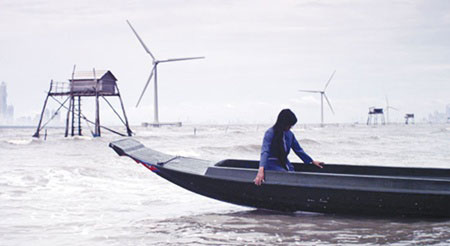
A cli-fi movie from Vietnam in 2014 titled ''Water-2030''


Climate change film, US, MVFF, international awards, filmmakers
A still from ''Water-2030'', directed by Nguyen Vo Nghiem Minh in Vietnam.

 
''Water-2030,'' directed by Nguyen Vo Nghiem Minh, is a 98-minute film, which is a fusion of different genres (apocalyptic film, cli-fi, thriller and romance), and is set in the year 2030, when most of the cultivable land in southern Vietnam has been submerged by water due to extreme climatic changes.

It is a beautiful film that blends elements of romance, murder, mystery and tales of vengeance to dramatise the Mekong Delta's impending environmental nightmare.

In the near-future southern Viet Nam, where rising water levels have displaced 80 per cent of the people and vegetables are scarce, the human survivors live on houseboats and catch fish or whatever's left of them.

A corporation operates a floating farm nearby, using desalination methods, solar power and, it's rumoured, some methods of ominous significance. When her husband is found dead, young widow Sao gets a job at the farm so that she can find his killer.

"Though climatic changes have caused increasing concern worldwide, the issue has yet to get its due attention in several places, including Viet Nam. I hope my film would help raise an alarm among such communities," director Nguyen says.

Director Nguyen was born in Vietnam in 1956. He studied in France, and then moved to the USA. He worked as a physicist before embarking on his filmmaking career.

His directorial debut ''Mua Len Trau'' (Buffalo Boy) was screened at festivals including Toronto, Locarno and Busan.

REFERENCES:

2030 (Vietnamese: Nước) is a 2014 Vietnamese cli-fi movie written and directed by Nghiem-Minh Nguyen-Vo. The film was in selected as the opening night film in the Panorama section at the 64th Berlin International Film Festival in February 2014.[1][2] It was awarded the Tribeca Sloan Filmmaker Award from the Tribeca Film Institute and the Alfred P. Sloan Foundation. [3]


Plot[edit]

In the year 2030, water levels have risen due to global climate change. South Vietnam is one of the regions worst affected by climate change, which causes as much as half the farmland to be swallowed by water. To subsist, people have to live on houseboats and rely solely on fishing with a depleting supply. Huge multinational conglomerates compete to build floating farms equipped with desalination and solar power plants floating along the coastline to produce the needed vegetables that have become highly priced commodities. A young woman is on a journey to find out the truth about the murder of her husband whom she suspects has been killed by the people of a floating farm. In the process, she discovers the secret of that floating farm; it employs genetic engineering technology to cultivate vegetables that can be grown using salt water thus can be produced much cheaper. This untested technology can have dangerous health consequences for the consumers that the farm wants to keep as a secret. It turns out that the chief scientist of the floating farm in question; the main suspect of her husband's death was her ex-lover. She ends up finding out different versions of the “truth” about her husband's death and has to make a dramatic decision without knowing the absolute truth..[4]

Cast[edit]

  • Quỳnh Hoa as Sáo
  • Quý Bình as Giang
  • Thạch Kim Long as Thi
  • Hoàng Trần Minh Đức as Thủy
  • Hoàng Phi as Thành

References[edit]

External links[edit]